Cloud Managed vs On Prem for SMB Networks
Table of Contents
- Cloud Managed vs On Prem: The Core Difference
- Start With the Work Your Team Can Sustain
- Compare Cost Beyond the First Purchase
- Control, Customization, and Change Management
- Security Is an Operating Model, Not a Hosting Location
- When Cloud Management Usually Fits Best
- When On-Prem Management Is Worth the Effort
- Make the Decision Before the Quote Gets Complicated
- FAQs
A network refresh can look straightforward until the first licensing quote, hardware lead time, and security requirement land on your desk. The cloud managed vs on prem decision affects more than where management software runs. It changes your team’s daily workload, long-term costs, troubleshooting process, and ability to keep remote sites operating reliably.
For IT teams supporting 100 to 250 employees, the right answer is rarely about chasing the newest model. It is about choosing an approach your staff can support confidently when a switch fails at a branch, a new location opens, or an audit asks how access is controlled.
Cloud Managed vs On Prem: The Core Difference
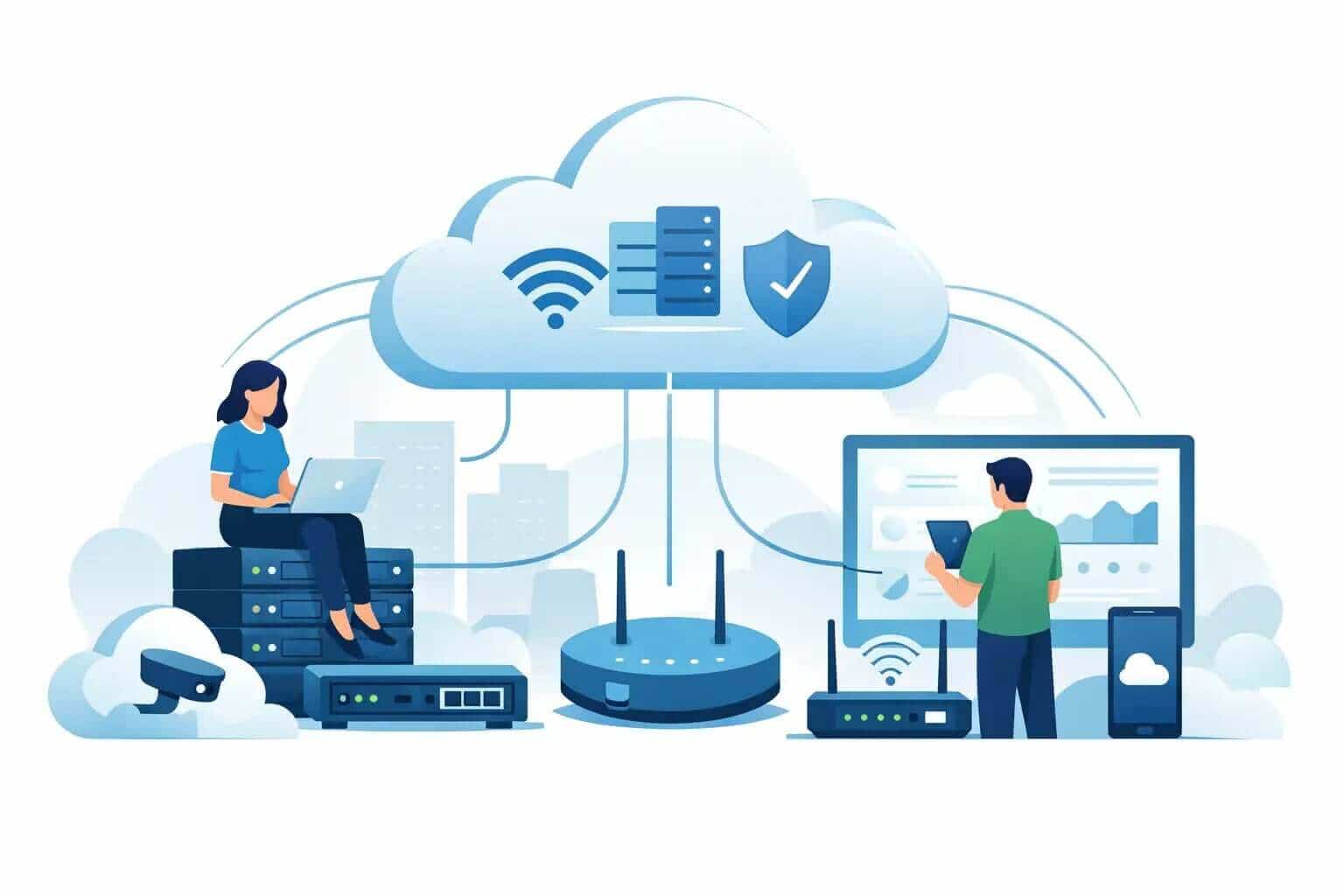
Cloud-managed networking uses a vendor-hosted management platform to configure, monitor, and troubleshoot network devices. Administrators sign into a web dashboard, while access points, switches, firewalls, and security appliances receive their policies from the cloud. The devices still handle local traffic, but the management plane is hosted elsewhere.
On-premises management keeps the controller, management server, or appliance inside your environment. Your team owns the management platform, its updates, backups, availability, and lifecycle along with the network hardware itself.
The operational difference is meaningful. A cloud-managed platform typically gives a lean IT team one place to see multiple sites, apply templates, review alerts, and make changes without maintaining a separate server. An on-prem model gives you more direct control over the management environment, but it also gives your team another system to patch, secure, and support.
Neither approach automatically produces a better network. Good design, correct hardware selection, resilient internet connectivity, and clear security policies matter in both models.
Start With the Work Your Team Can Sustain
A small IT team often has broader responsibilities than networking alone. They are also handling user support, endpoint security, SaaS administration, backups, and projects. For that team, cloud management can reduce routine effort because it removes controller maintenance and makes multi-site visibility easier.
That does not mean cloud-managed networking is maintenance-free. Firmware planning, alert tuning, user access, license renewals, configuration standards, and incident response still require ownership. The difference is that your staff spends less time maintaining the management infrastructure itself.
On-prem management makes more sense when the organization has a strong internal infrastructure team, specific data-control requirements, or a network environment that must operate independently of external cloud management services. It can also fit organizations with established processes for hosting, monitoring, backing up, and securing internal applications.
Ask a practical question: if the person who knows the controller best is on vacation, can someone else maintain it and restore it? If the answer is no, the apparent control of an on-prem model may create operational risk.
Compare Cost Beyond the First Purchase
Cloud-managed solutions often shift part of the cost from upfront capital expense to recurring licensing. That can be easier to budget for, especially during a refresh, but it requires discipline. Licenses may be tied to individual devices, feature tiers, or support terms. A network that looks affordable in year one can become harder to plan for if renewal dates and coverage levels are not tracked carefully.
On-prem solutions may have higher upfront costs for controllers, servers, virtual infrastructure, software, and redundant management components. The recurring subscription cost may be lower in some designs, but the internal labor cost is real. Patching a server, managing certificates, replacing failed storage, and supporting an outdated controller all consume time that rarely appears on a purchase order.
When comparing options, model the total cost over three to five years. Include hardware, licenses, support coverage, implementation time, management infrastructure, expected refresh cycles, and the cost of an outage. A lower device price does not help if it results in a design that is harder to support or expand.
Control, Customization, and Change Management
On-prem environments generally provide more direct control over the management stack. That can be valuable for organizations with custom integrations, strict internal change processes, or specialized network requirements. You decide when to upgrade the management platform, where it runs, and how it is backed up.
The trade-off is responsibility. Delaying updates can create security exposure or compatibility problems. Running older controller versions can also complicate a hardware refresh, especially when new devices require newer software.
Cloud platforms are usually more standardized. That means less flexibility at the deepest level, but faster deployment for common use cases. Standardization is not a weakness for many SMBs. A repeatable configuration for headquarters, warehouses, retail sites, and remote offices can reduce errors and make troubleshooting faster.
The better question is not, “Do we need maximum control?” It is, “Which controls do we actually use, and can our team manage them reliably?” For many organizations, a defined set of supported configurations is more valuable than an unlimited set of options.
Security Is an Operating Model, Not a Hosting Location
Some teams assume on-prem management is inherently more secure because the management system stays inside the building. Others assume a cloud platform is automatically safer because the provider handles the service. Both assumptions are incomplete.
Security depends on identity controls, role-based access, multi-factor authentication, logging, segmentation, patching, secure configuration, and how quickly the team responds to alerts. Cloud management can simplify these tasks through centralized visibility and policy enforcement. On-prem management can support strict internal controls, but only when the organization has the people and processes to maintain them.
Consider your internet dependency as well. If cloud management becomes temporarily unavailable, most properly designed network devices continue forwarding traffic using their last known configuration. However, administrators may lose the ability to make changes, view current status, or access cloud-based troubleshooting tools until service returns. For critical sites, document what continues to function and what cannot be managed during an outage.
When Cloud Management Usually Fits Best
Cloud-managed networking is often a strong fit for distributed businesses, fast-growing companies, and organizations with limited IT staff. Manufacturing companies can use it to standardize warehouse and plant connectivity. Retail teams can manage many locations from one dashboard. Professional services firms can support branch offices without deploying management servers at each site.
It is especially useful when the priorities are faster deployment, consistent configurations, centralized monitoring, and reduced infrastructure overhead. A new site can be staged before shipment, then brought online with a predictable process. That reduces the chance that an installation turns into an all-day troubleshooting event.
Cloud management is less attractive when your environment has hard requirements for isolated operations, highly customized workflows, or internal policy restrictions that rule out vendor-hosted management. Those requirements should be validated early, not discovered after hardware has been ordered.
When On-Prem Management Is Worth the Effort
On-prem management can be the right choice for organizations that need tight control over their management environment and have the capacity to operate it well. This may include businesses with mature internal data centers, specialized compliance expectations, or environments with limited or unreliable external connectivity.
It also makes sense when the network design depends on capabilities that a cloud-managed platform does not support in the way your business needs. That is a technical fit question, not a philosophical preference. Confirm feature requirements before selecting an architecture, including segmentation, authentication, routing, logging, redundancy, and integration needs.
If you choose on-prem, treat the controller as production infrastructure. Define ownership, monitoring, backup and restore procedures, patch windows, failover expectations, and replacement plans. A controller that has no documented recovery plan can become a single point of failure during the worst possible moment.
Make the Decision Before the Quote Gets Complicated
When deciding between cloud managed vs on prem, the cleanest projects begin with a short design review, not a part-number list. Document the number of locations, users, devices, uplinks, wireless coverage areas, security requirements, growth expectations, and available IT resources. Then identify which management tasks are creating the most friction today.
A few questions usually clarify the path quickly:
- Does your team need to manage multiple locations without maintaining controller infrastructure?
- Are recurring licenses acceptable if they reduce internal support work?
- Do security, compliance, or connectivity requirements require local management?
- Will the design still work when you add a site, replace a switch, or lose an internet connection?
The goal is not to force every network into cloud or on-prem management. It is to avoid buying a platform that creates more work than your team can realistically absorb.
Before finalizing a refresh, validate device compatibility, licensing terms, support coverage, and the deployment plan with someone who understands the full configuration. Hummingbird Networks has spent more than 20 years helping IT teams make those decisions with faster quotes, technical validation, and practical guidance. Get a Quote or Validate My Configuration before the order is placed - that is usually the easiest time to prevent a costly surprise.
FAQs
What is the difference between cloud-managed and on-premises networking?
Cloud-managed networking uses a vendor-hosted platform to configure and monitor network devices. On-premises networking keeps the controller or management system within the organization's own environment.
Is cloud-managed networking better for small IT teams?
It can be. Cloud management can reduce controller maintenance and make it easier to monitor and manage multiple locations from one place.