Cloud Managed vs Traditional Networking

Table of Contents
- What cloud managed vs traditional networking really means
- Where cloud-managed networking usually wins
- Where traditional networking still makes sense
- Cost is not just hardware vs licensing
- Security and control: the trade-off that matters
- Staffing is often the deciding factor
- How to choose the right model for your business
- FAQs
When a 150-person company has one network admin, maybe a systems engineer, and a long list of competing priorities, network design stops being a theoretical exercise. It becomes a staffing decision. That is why cloud managed vs traditional networking is not just about features. It is about how much time your team has, how much control you need, and how much operational complexity your business can realistically support.
For most small to midsize IT teams, the real question is not which model is better on paper. It is which model helps you keep sites online, make changes quickly, and avoid buying yourself a management problem you do not have the people to handle.
What cloud managed vs traditional networking really means
Cloud-managed networking shifts a large part of day-to-day administration into a web-based dashboard. Your team can configure switches, access points, security policies, and site settings centrally, often across multiple locations, without needing to log into each device one by one. Visibility tends to be easier, firmware management is more guided, and remote troubleshooting is usually faster.
Traditional networking relies more heavily on device-level management, local controllers, command-line configuration, and on-premises tooling. That can offer more granular control and may fit teams that already have deep networking expertise in-house. It also tends to demand more hands-on administration.
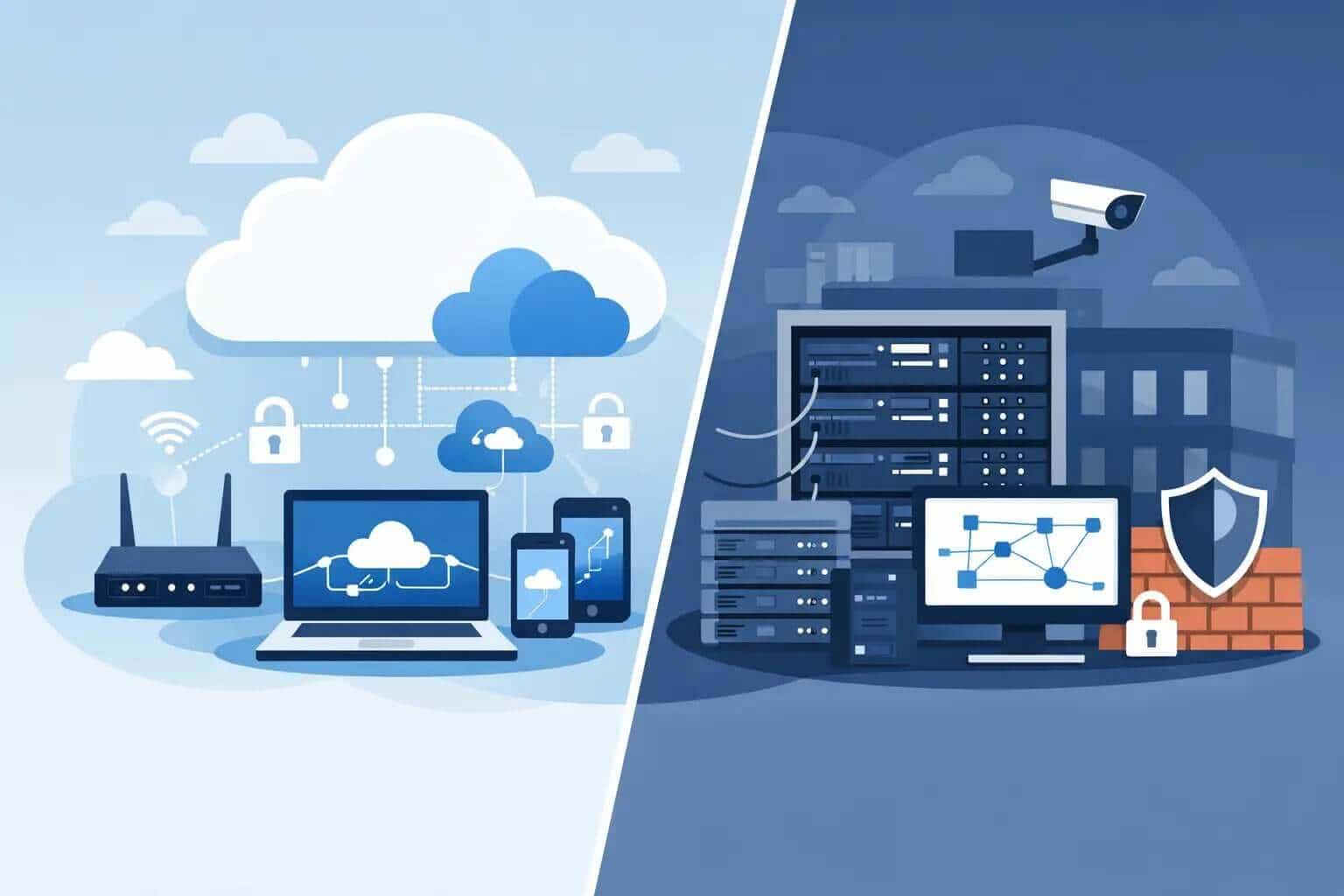
The gap between these approaches is not absolute. Some environments blend both. But in practice, cloud-managed networks usually favor simplicity, centralized visibility, and operational speed, while traditional networks favor customization, direct control, and established workflows.
Where cloud-managed networking usually wins
If your team supports multiple branch offices, remote users, or lean IT operations, cloud-managed platforms can remove a lot of friction.
The biggest advantage is time. A small IT team can push consistent settings to many sites, check device health from one place, and handle routine changes without rolling a truck or jumping through a VPN into each location. For retailers, manufacturers with distributed facilities, and professional services firms with satellite offices, that matters more than a long list of advanced capabilities nobody has time to use.
Cloud-managed networking also tends to reduce the skill burden for common tasks. That does not mean it is simplistic. It means the platform is designed to make standard deployment, monitoring, and policy enforcement more accessible. If your business depends on one or two generalist IT people rather than a dedicated network engineering bench, that usability can be a major operational benefit.
There is also the consistency factor. Standardizing templates across locations makes it easier to avoid configuration drift. That lowers the chance of subtle site-to-site differences becoming outages or security gaps later.
Where traditional networking still makes sense
Traditional networking is not old-fashioned by default. In some environments, it is the right answer.
If your team needs deep protocol-level control, highly customized segmentation, or complex local integrations, traditional architectures can provide more flexibility. Organizations with specialized compliance requirements, heavily customized campus environments, or experienced network engineers may prefer direct access to low-level controls rather than abstracting them through a dashboard.
There is also a financial and operational reality to consider. Some businesses already own traditional infrastructure, have internal expertise built around it, and do not gain enough from changing models to justify the disruption. If the current environment is stable, the team knows how to run it, and the business is not asking for faster multi-site deployment or easier remote administration, keeping a traditional approach may be perfectly reasonable.
This is where a lot of buying mistakes happen. Teams hear that cloud-managed is easier and assume easier means better for every environment. It does not. Easier only helps if it aligns with the actual demands on your network and your staff.
Cost is not just hardware vs licensing
One of the most common mistakes in a cloud-managed vs traditional networking comparison is treating cost as a simple line-item difference.
Cloud-managed environments often involve ongoing licensing. That can make the price more visible and, in some cases, harder to stomach for teams used to thinking in capital expense terms. Traditional networking may look less expensive if you focus only on licensing or device cost.
But that is only part of the story.
The better question is what your team spends in labor, troubleshooting time, travel between sites, deployment delays, and downtime risk. If cloud management lets one admin support ten sites instead of constantly firefighting at three, the labor equation changes fast. If centralized visibility helps catch problems before users notice them, that also has value, even if it never shows up neatly in a hardware comparison.
On the other hand, if you have a capable internal networking team and a stable single-site environment, traditional networking may remain cost-effective over time. You may not need the convenience layer enough to justify recurring licensing.
For SMBs, this usually comes down to whether you are optimizing for lower visible spend or lower operational burden. Those are not always the same thing.
Security and control: the trade-off that matters
Security conversations around networking often get oversimplified. Cloud-managed does not automatically mean less secure, and traditional does not automatically mean safer.
Cloud-managed platforms can improve security hygiene by making firmware updates, policy consistency, and visibility easier to maintain. For overstretched IT teams, that alone can reduce real risk. A system that is easier to monitor and keep current is often more secure in practice than a highly customizable environment that nobody has time to review properly.
Traditional networking can offer deeper control over how systems are configured and segmented. That matters in environments where your security team or network engineers need exact behavior and do not want to depend on a vendor-managed interface for core workflows.
The real question is not which model sounds more secure. It is which model your team can operate well, patch consistently, and troubleshoot confidently. Security failures often come from complexity, inconsistency, and lack of visibility, not from architecture labels.
Staffing is often the deciding factor
For IT managers and directors at 100 to 250 employee companies, staffing is usually the deciding factor, even if nobody says it that way in the planning meeting.
If your network depends on one person who also handles endpoints, Microsoft 365, firewalls, vendors, and user escalations, traditional networking can become fragile simply because too much expertise sits in too few hands. A cloud-managed model can reduce that dependency by making routine management more accessible and more centralized.
If you have a dedicated networking team or strong MSP support, traditional networking may be easier to justify. In that case, the business may actually benefit from the extra flexibility and deeper controls.
This is why architecture decisions should be tied to operating model, not just feature checklists. Your network has to fit the team that will run it six months after the project is complete.
How to choose the right model for your business
Start with your environment, not the marketing.
If you have multiple sites, a lean IT team, frequent adds and changes, and pressure to standardize quickly, cloud-managed networking is often the better fit. It tends to reduce administrative friction and make distributed networks easier to support.
If you run a more complex environment, have strong networking talent in-house, or need detailed customization that your team actively uses, traditional networking may be the better long-term choice.
Many businesses land in the middle. They might standardize branch offices on a cloud-managed platform while keeping more complex core or data center functions in a traditional model. That hybrid approach can be practical, especially during refresh cycles when replacing everything at once does not make sense.
What matters most is validating the design before you buy. Compatibility, licensing, management expectations, and rollout planning all affect whether a networking project goes smoothly or turns into rework. That is one reason buyers often want more than a shopping cart. They want someone to sanity-check the configuration, pricing, and deployment path before the order is placed.
| Category | Cloud-Managed Networking | Traditional Networking |
|---|---|---|
| Management | Centralized through a cloud dashboard | Managed device-by-device or through on-premises tools |
| Ease of Administration | Simplifies routine tasks and multi-site management | Requires more hands-on administration and expertise |
| Remote Management | Easily manage sites from anywhere | Often requires VPN access or local connectivity |
| Deployment Speed | Faster deployment with templates and centralized policies | More manual configuration and setup |
| Scalability | Well-suited for growing multi-site environments | Can require additional management effort as networks grow |
| Customization | Streamlined and standardized management | Greater control and deeper customization options |
| Staffing Requirements | Ideal for lean IT teams with limited resources | Better suited for organizations with dedicated networking expertise |
| Operational Overhead | Lower day-to-day management burden | Higher administrative and maintenance workload |
| Security Management | Simplifies updates, visibility, and policy consistency | Provides granular control over security configurations |
| Best Fit | SMBs, distributed organizations, and lean IT teams | Complex environments with advanced networking requirements |
For teams that buy Cisco and Meraki regularly, that validation step can save more time than any product feature. Hummingbird Networks has spent more than 20 years helping IT teams make those decisions with faster quoting, technical review, and fewer procurement surprises.
If you are weighing cloud managed vs traditional networking, the best answer usually comes from mapping three things honestly: your team capacity, your site complexity, and how fast the business expects IT to move. Get that part right, and the technology choice gets much clearer.
If you want a useful next step, validate the configuration before the refresh is locked in. A network is a long-term operational decision, not just a line on a quote.
FAQs
What is the difference between cloud-managed and traditional networking?
Cloud-managed networking centralizes management through a web-based dashboard, while traditional networking relies on device-level administration and on-premises tools.
Is cloud-managed networking better for small IT teams?
Yes, cloud-managed networking can simplify deployment, monitoring, and troubleshooting, making it easier for lean IT teams to support multiple locations.