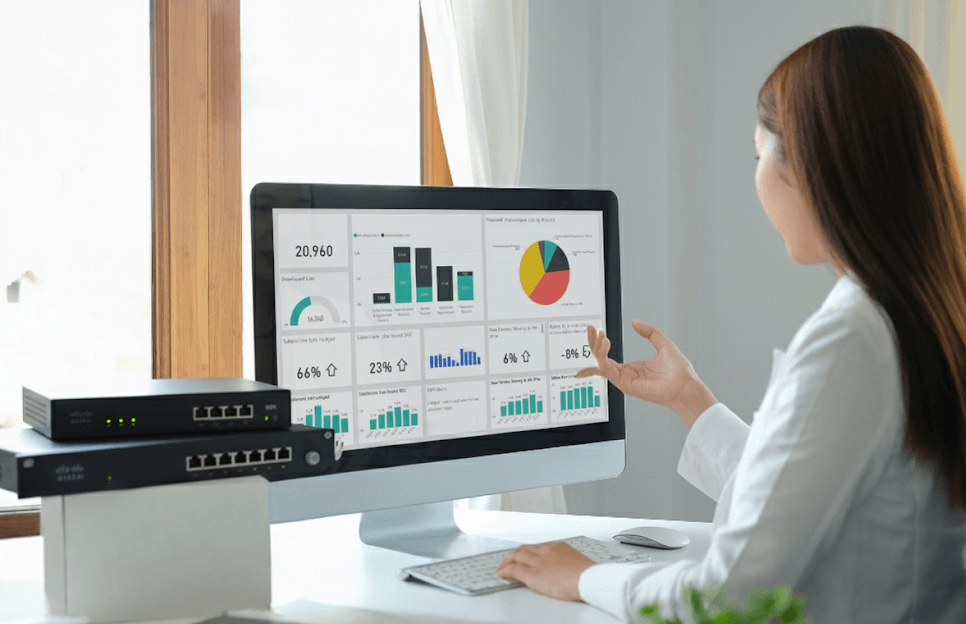
Protecting Your Assets With Meraki MT Sensors

Table of Contents
- Why Your IT Environment Demands Monitoring
- Every MT Sensor In The Meraki Lineup
- Environmental Sensors For Temperature And Air Quality Monitoring
- Leak Detection Sensor For Damage Prevention
- Access Sensor For Securing Doors And Spaces
- Smart Automation For Actions And Power Control
- Are Meraki MT Sensors Worth The Investment
- Get A Complete Sensor Strategy From A Trusted Partner
- FAQs
You’ve probably got plenty of monitoring tools already. But how much real visibility do you have inside your environment? Meraki MT sensors provide IT teams with real-time insights into temperature, air quality, water leaks, access points, and electrical power. And they do it with the same simplicity that makes the rest of the Meraki stack so popular.
Whether you’re managing a single comms closet or a multi-site network, MT sensors are designed to catch small problems before they become expensive disasters. Let’s break down what these sensors offer, and how to tell if they’re worth the investment.
Why Your IT Environment Demands Monitoring
Monitoring isn’t just about uptime anymore; it’s about control. Without visibility into your physical environment, you’re left guessing about risks that can silently damage your infrastructure. And for most IT pros, these threats show up at the worst time: overheating racks, failed cooling, unexpected moisture, or access violations. If you’re only focused on what your switches and firewalls are doing, you’re missing half the picture.
Meraki MT sensors fill that gap. They help you see beyond digital alerts into the real-world conditions your network runs on. These aren’t luxury add-ons; they’re essential tools for avoiding preventable damage, reducing downtime, and managing physical spaces without needing boots on the ground. Whether it’s a server closet or a remote office, you’ll know what’s happening and what to do next.
Every MT Sensor In The Meraki Lineup
The MT family covers a range of physical monitoring needs, all under the same dashboard. If you’ve ever had to mix and match third-party sensors, you already know how clunky and fragmented that setup can be.
This table provides a top-level overview of the MT portfolio, detailing what each model does, where it fits best, and how it integrates.
Model | Category | Key Features | Typical Use Cases | Needs MR/MV? | Licensed? |
MT10 | Temp + Humidity | Tracks ambient temp and humidity | IDFs, comms closets, HVAC equipment | ✅ | ✅ |
MT11 | Probe (Cold Storage) | Includes probe for cold-chain monitoring | Fridges, freezers, food/pharma/clinical use | ✅ | ✅ |
MT12 | Water Leak | Leak detection via cable or probe | Under-sink, basements, server racks near plumbing | ✅ | ✅ |
MT14 | Indoor Air Quality | VOCs, PM2.5, noise, humidity, temp | Offices, classrooms, shared spaces | ✅ | ✅ |
MT15 | IAQ + CO₂ | Adds CO₂ monitoring to IAQ functionalities | Meeting rooms, classrooms, high-occupancy zones | ✅ | ✅ |
MT20 | Door Open/Close | Magnetic sensor for open/close detection | Rack cabinets, server room doors, closets | ✅ | ✅ |
MT30 | Smart Automation Button | Push-button for triggering workflows | Support tickets, security alerts, event actions | ✅ | ✅ |
MT40 | Smart Power Controller | Monitors power draw and outages via outlet plug | PoS, appliances, UPS, critical gear endpoints | ✅ | ✅ |
Environmental Sensors For Temperature And Air Quality Monitoring
Environmental stability is the backbone of uptime. It’s not glamorous, but it’s critical. Most network failures aren’t caused by flashy cyberattacks; they’re caused by overheated gear or slow-burning infrastructure issues. If your HVAC dies over a weekend, or your switch is stuck in a poorly ventilated closet, it doesn’t take long for performance to suffer.
That’s where Meraki’s environmental sensors come in. These models are designed to track the factors that impact both hardware health and human comfort. Whether you’re trying to meet air quality standards or prevent equipment damage, these sensors give you the data you need to act fast and plan smarter.
MT10 (Temperature and Humidity Sensor)
The MT10 is your everyday environmental watchdog. It tracks both temperature and humidity in the spaces where your gear lives, especially IDFs, wiring closets, and server racks. Think of it as a simple “check engine” light that helps you avoid thermal shutdowns or corrosion due to excess moisture.
Dual sensing for temp and humidity: Monitors ambient environmental changes that can harm sensitive IT gear.
Threshold-based alerting: Sends real-time notifications when readings exceed defined ranges.
Trend reporting over time: Helps identify recurring HVAC or airflow issues with historical data.
Wireless deployment in tight spaces: Mounts easily in server racks, comms closets, or above ceiling tiles.
Runs on BLE and dashboard native: Communicates through MR/MV devices for full Meraki integration.
MT11 (Temperature Probe Sensor)
Need cold-chain monitoring? The MT11 adds a probe that lets you measure internal temperatures for high-sensitivity environments, like those found in food service, pharmaceuticals, and clinical labs. This is what you want if you need to meet cold storage compliance standards or log temps for audits.
External probe for precision placement: Insert the probe into storage units while keeping the sensor outside.
Built for extreme cold environments: Handles freezers and medical-grade storage down to -40°C.
Audit-friendly logging: Automatically logs and stores temperature readings for inspection readiness.
Real-time deviation alerts: Instantly flags potential spoilage or regulatory violations.
Non-invasive installation: Cable and sensor mount easily without drilling into units.
MT14 (Air Quality Sensor)
The MT14 takes environmental monitoring further by tracking VOCs (volatile organic compounds), particulate matter (PM2.5), noise levels, humidity, and temperature. It’s designed for people-centered environments: offices, classrooms, and conference spaces. With this, you’re not just protecting equipment, you’re protecting air quality and employee health.
VOCs and particulate detection: Measures indoor pollutants that impact health and comfort.
Sound level monitoring: Tracks ambient noise to assess productivity zones or excessive distractions.
Humidity and temp tracking: Offers full environmental snapshots for workspace optimization.
Automated air quality alerts: Flags rising pollution levels or HVAC system issues.
Ideal for shared workspaces: Ensures indoor conditions meet modern health standards.
MT15 (Air Quality and CO₂ Sensor)
The MT15 adds CO₂ tracking to the MT14’s already strong sensor set. Why does that matter? Because CO₂ levels correlate with air circulation and cognitive performance. In a high-density meeting room or packed classroom, this sensor helps facilities teams maintain air quality that keeps people alert, safe, and productive.
CO₂ sensing for occupancy monitoring: Identifies poorly ventilated areas where air turnover is too low.
Complete IAQ coverage: Tracks temperature, humidity, VOCs, particulate matter, noise, and CO₂ in a single device.
Supports air-exchange planning: Provides data for adjusting HVAC cycles or filtration in real time.
Designed for high-traffic areas: Ideal for conference rooms, lecture halls, and shared office zones.
Helps meet indoor air benchmarks: Supports wellness and safety programs with hard data.
Leak Detection Sensor For Damage Prevention
Leaks aren’t just a facilities issue; they’re an IT disaster waiting to happen. Water damage can fry equipment, take down critical services, and trigger insurance claims you never saw coming. And the worst part? Most leaks go unnoticed until it’s too late. That’s why leak detection has become a must-have in any server room, rack closet, or equipment-adjacent area.
The Meraki MT12 helps you find these threats early. It doesn’t just warn you when there’s a problem; it gives you enough time to prevent a serious outage. For lean teams, this kind of proactive monitoring is often the difference between a quick mop-up and a full-blown infrastructure replacement.
MT12 (Water Leak Detection Sensor)
The MT12 detects water leaks using a flexible cable or probe. It’s perfect for deployment under HVAC units, next to water heaters, or anywhere moisture is a risk.
Leak sensing cable or probe: Detects moisture across long runs or pinpoint spots.
Custom cable lengths available: Tailor detection zones under racks or along baseboards.
Fast response to first signs of water: Reduces downtime and damage from slow, hidden leaks.
Install under high-risk equipment: Ideal for HVAC closets, basements, or behind appliances.
Water-resistant construction: Built to survive harsh placement environments.
Access Sensor For Securing Doors And Spaces
Most IT security strategies focus on digital controls, firewalls, endpoint detection, zero trust. But physical access still matters. If someone can walk into your server room, unplug your gear, or pop open a rack, that’s a vulnerability no software patch can fix. The Meraki MT20 brings that visibility into the physical world.
It helps you know exactly when and where access happens, even at sites you don’t visit regularly. Whether you’re tracking after-hours maintenance or setting up alerts for unauthorized entry, this sensor turns physical spaces into monitored endpoints, complete with logs, alerts, and accountability.
MT20 (Door Open/Close Sensor)
The MT20 is a magnetic sensor that tracks when doors or cabinets are opened or closed. It’s simple but powerful.
Open/close status tracking: Monitors when secured areas are accessed in real time.
Triggers alerts on unauthorized access: Helps prevent physical tampering or data theft.
Audit log generation: Records every event for compliance or internal investigations.
Works on racks, rooms, and storage: Flexible install options from cabinets to doors.
Clean dashboard integration: No additional software, just Meraki simplicity.
Smart Automation For Actions And Power Control
Reactive alerts are great. But what if you could respond automatically? The MT30 and MT40 take the MT lineup a step further by giving you control, not just insight. They let you trigger workflows, log manual actions, and even power cycle remote gear, all without waiting for someone to be on site.
These aren’t just “nice-to-haves” for large enterprises. For SMBs managing multiple locations with lean staff, this kind of automation saves real time, money, and sanity. Whether you need to restart a PoS terminal or launch a support process with one click, these sensors give your team faster ways to respond.
MT30 (Smart Automation Button)
The MT30 is a customizable push-button. You can mount it in a help desk, lab, or security booth to kick off alerts, open tickets, or trigger specific automations.
Single-button trigger for actions: Use it to execute pre-configured automations instantly.
Fully customizable workflows: Integrates with Meraki APIs and external platforms.
On-demand incident response: Launch security protocols or support tickets with one touch.
Visual confirmation with LED feedback: Lights up to confirm press and reduce misuse.
Versatile for physical deployments: Wall-mounted in labs, offices, or restricted zones.
MT40 (Smart Power Controller)
The MT40 plugs into a standard outlet and gives you remote control and monitoring of power draw.
Real-time power draw monitoring: View current and historical load levels per outlet.
Instant alerting on failure or spikes: React fast to outages, brownouts, or instability.
Remote device reboot capability: Power cycle unresponsive gear without a truck roll.
Tracks uptime of connected hardware: Identifies repeated failures or early hardware issues.
Ideal for critical endpoints: Use with modems, switches, UPS units, and industrial gear.
Are Meraki MT Sensors Worth The Investment
Smart gear always comes with a price tag, but so does downtime, failed audits, and last-minute fire drills. The question most teams ask isn’t whether MT sensors work. It’s whether they justify the cost. And for most SMBs managing multiple spaces, the answer tends to be yes.
These sensors aren’t designed to impress in a demo. They’re designed to save you when something goes wrong, or better yet, before it does. The value is in the data, the alerts, and the simplicity of managing everything in one place. The less time you spend chasing physical issues, the more time you can spend scaling and securing your infrastructure.
Get A Complete Sensor Strategy From A Trusted Partner
Sensors alone don’t fix problems, but having the right ones installed in the right places gives you control. If you’re already running Meraki gear, adding MT sensors is an easy next step that closes real monitoring gaps. And if you’re new to the Meraki ecosystem, this is a smart place to start.
You don’t need to roll them out everywhere at once. Start with the pain points — the forgotten closet, the cold storage unit, the leaky basement. From there, build a strategy that fits your risk tolerance, compliance needs, and physical footprint, with a partner who knows how this all works.
If you’re working with Meraki gear already, Hummingbird Networks can help ensure your sensor rollout doesn’t waste time or stack on complexity. We’ve worked through the licensing quirks, the MR/MV pairing limitations, and the weird closet placements that trip up deployments. If you want help, we’ll give you the kind that actually helps.
Ready to take the next step in protecting your environment? Explore the Meraki MT sensor lineup and select the right components for your monitoring strategy.
FAQs
Do Meraki MT sensors require a specific gateway or controller to function?
Yes. MT sensors operate using Bluetooth Low Energy (BLE) and require a compatible, powered-on Meraki MR access point or MV smart camera within range to act as a gateway. This gateway securely connects the sensors to the Meraki dashboard, eliminating the need for a separate, dedicated hardware controller.
What is the effective wireless range between an MT sensor and its gateway?
The operational range depends heavily on the physical environment, including wall materials (concrete, glass, drywall), RF interference from other 2.4 GHz devices, and the physical line of sight between the sensor and the gateway. In a typical office environment, you can generally expect a reliable BLE range of up to 20-30 meters (approximately 65-100 feet). For best performance, it is recommended to have a gateway in the same room or an adjacent space, and you can verify signal strength for each sensor in the Meraki dashboard.
How long does the Meraki dashboard store historical data for MT sensors?
The sensors provide historical data for trend reporting and generate audit logs. The Meraki dashboard stores this granular sensor data for 30 days, allowing you to view and analyze recent trends. For compliance or analysis requiring longer retention periods, you can use the Meraki API to export this data to a third-party data warehouse or logging platform for indefinite storage.
How is licensing handled for the MT sensor portfolio?
Each Meraki MT sensor requires its own individual license to function and be managed within the Meraki dashboard. The licensing model is consistent with other Meraki products, where the license provides access to cloud management, software updates, and support. For streamlined management, licenses are typically co-terminated to align with your organization's single expiration date.
Beyond the Meraki dashboard, how can MT sensor events be integrated into other IT management and alerting systems?
The Meraki platform is built with API-first principles. The MT30 Smart Automation Button is a prime example, designed to trigger customizable workflows via Meraki APIs to integrate with external platforms for actions like creating a support ticket or initiating a security protocol. Similarly, alerts from any MT sensor can be configured to send webhooks to third-party services, allowing for robust integration with systems like PagerDuty, Slack, or other network monitoring tools.
What is the typical battery life, and are the batteries user-replaceable?
Most Meraki MT sensors are designed for multi-year battery life, typically up to five years, depending on the model and reporting frequency. They use standard AA batteries that are user-replaceable. The MT40 Smart Power Controller is an exception, as it is mains-powered and plugs directly into an outlet. The Meraki dashboard provides low-battery warnings well in advance, allowing for planned maintenance.
Can alerting rules be configured with multi-conditional or time-based logic?
The Meraki dashboard natively supports threshold-based alerting, which sends a notification when a specific reading exceeds a defined range. While the native UI does not currently support complex multi-conditional (e.g., IF temperature > X AND humidity > Y) or time-of-day alerting rules, this functionality can be achieved. By sending alerts via webhooks to an intermediary automation platform (like Zapier, IFTTT, or a custom application), you can create virtually any conditional or time-based logic to control when and how final notifications are sent.